WordPress or Custom Website?
WordPress and custom development both build good websites. Compare cost, speed, flexibility and upkeep, and see which one suits your business.

Choose WordPress if you want a business site, blog or online shop live quickly on a modest budget and editable by your own team. Choose a custom build if you need unique features, complex integrations or special security and performance needs, and can invest more time and budget. Many businesses start on WordPress and add custom development later.
- 1WordPress is faster and cheaper to start, with an easy editor for non-technical teams.
- 2Custom development gives full control for complex features, at a higher cost and timeline.
- 3Neither choice guarantees speed, security or rankings. Good build and upkeep do.
- 4You can start on WordPress and add custom features, or move to a custom build later.
Choosing between WordPress and a custom-built website is one of the first big decisions in any web project, and the wrong choice is expensive to undo. This guide compares both in plain language so you can decide with confidence. It is written by ARYAN MIYA MANSOOR, who helps Nepal businesses plan websites that can be found on Google.
WordPress or custom website: the short answer
Neither is better in every case. WordPress suits most business websites, blogs and small shops. A custom build suits products with unique features or complex needs. The right choice depends on your goal, budget, timeline and who will manage the site afterwards.

What is WordPress development?
WordPress is a content management system that lets you build and edit a website without writing code for every page. You choose a theme for the design and add plugins for features such as forms, shops and SEO tools. Because it is widely used, there is a large pool of developers and plenty of documentation.
- Quick to launch: themes and plugins cover most common needs.
- Easy to edit: your team can update pages, posts and images without a developer.
- Flexible: thousands of themes and plugins, plus room for custom code when needed.
- Cost-friendly: a lower starting cost than building everything from scratch.
What is custom web development?
Custom development means designing and coding a website or web application specifically for your business, often with frameworks such as React, Laravel or Node.js. Every feature is built to your process. This is the route for booking systems, customer portals, marketplaces and tools that standard plugins cannot handle. If your project is an app rather than a website, see my AI app development service.
- Tailored: features and workflows fit your business exactly.
- Scalable: the structure can be designed for high traffic from the start.
- Controlled: you decide the stack, the security model and the integrations.
- Higher effort: it costs more, takes longer and needs developers for most changes.
WordPress vs custom development: side-by-side comparison
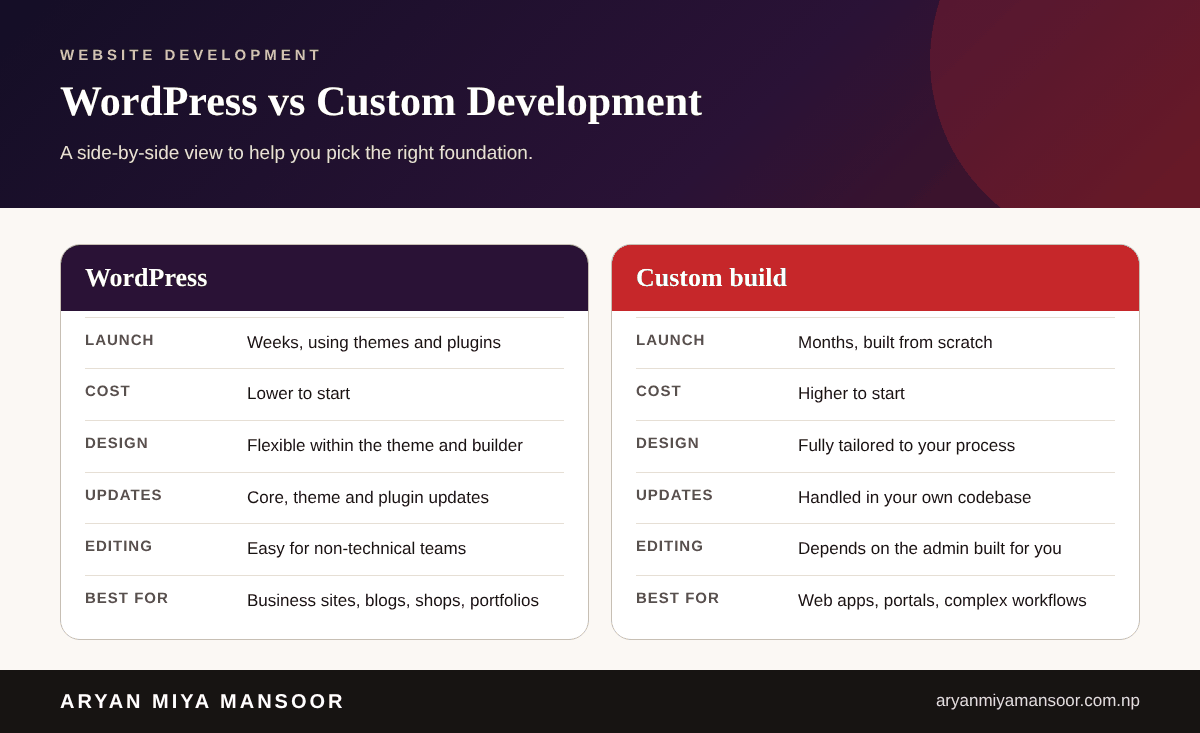
When WordPress is the best fit
You need to launch quickly
If you want to be online in weeks, WordPress with a clean theme is the practical route. You can improve it after launch.
You want affordable development
Ready-made themes and plugins reduce the amount of custom work, which keeps the budget manageable for startups and small businesses.
Your team will manage the content
WordPress is built for editors. If staff will publish posts and update pages, the familiar dashboard saves time and training.
You want to test an idea first
Launching on WordPress lets you check demand before investing in a bigger build.
When custom development is the better idea
You need unique features
Complex calculators, booking logic, multi-step workflows or customer dashboards often need custom code.
You have special performance or security needs
If traffic will be heavy or you handle sensitive data, a purpose-built structure with strict controls is safer than stacking plugins.
You must connect other systems
Links to accounting, inventory, CRM or payment systems may need custom integration work.
What about SEO, speed and security?
Both options can rank, load fast and stay secure, and both can fail if built badly. WordPress sites slow down when they carry too many plugins and heavy themes. Custom sites can have poor structure or missing basics if SEO is not planned. Whichever you choose, plan page titles, clean URLs, mobile speed and tracking from the start. Google's Core Web Vitals give a practical speed target, and my SEO packages cover the ongoing SEO work after launch.
Which should you choose?
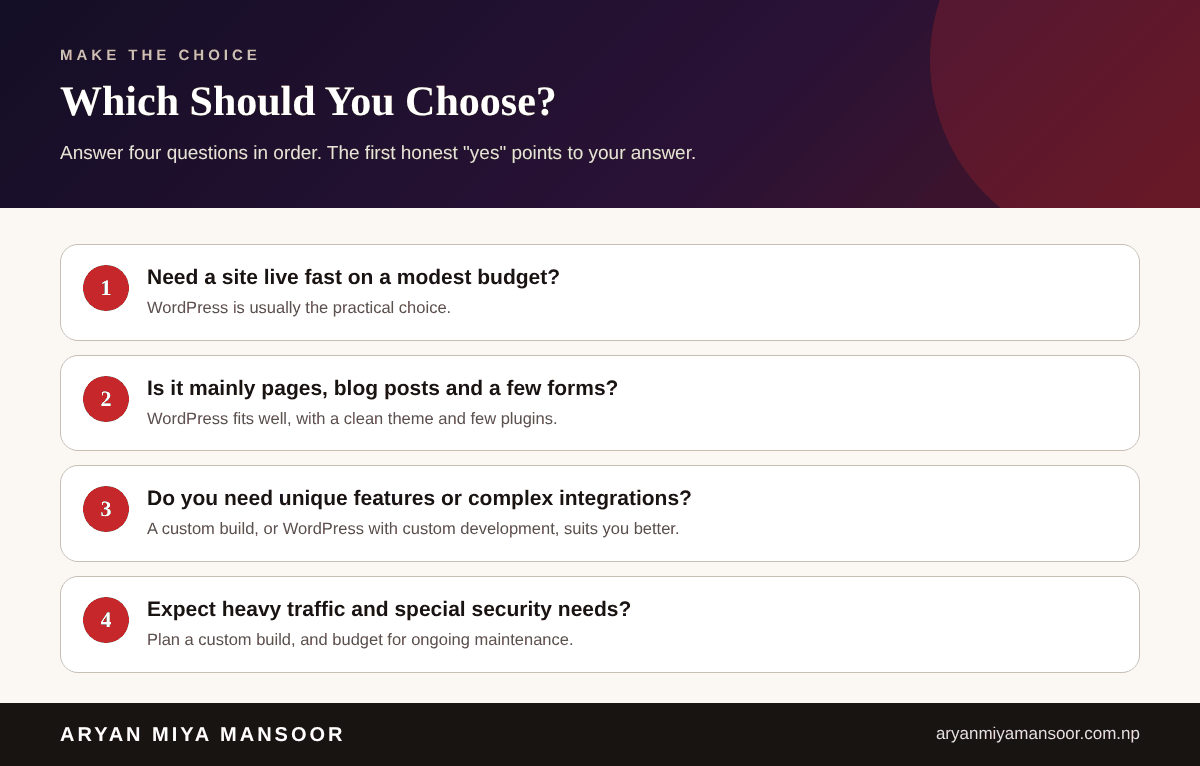
If you are still unsure, describe your goal and budget and I will give you an honest recommendation. You can also read my guide on AI in web development for business owners, or see my web development in Nepal and UI/UX design services.
Conclusion
WordPress and custom development each solve a different problem. WordPress gives speed, value and easy editing. Custom development gives control and unique features. Pick the one that matches your goal today, and remember that your platform can grow with you.
Related reading
Frequently asked questions
Related searches and topics
Need help applying this in your market?
Sources and further reading
This guide reflects my own hands-on experience and Google's published guidance at the date shown. Search changes, so check official documentation for the latest rules. Results vary by business and market; nothing here is a guarantee.
Aryan is Technical Director and SEO Manager at Softsaro Nepal and a senior SEO specialist with over 4 years of hands-on experience in SEO, Answer Engine Optimization and Generative Engine Optimization. He is based in Kathmandu, Nepal, and works remotely with businesses in Nepal and the UAE as an independent consultant, following Google’s published guidelines with no link schemes or ranking guarantees.