
Technical SEO, Simplified
Technical SEO makes sure search engines can find, understand and show your pages. Here are the basics and a nine-point checklist.

Technical SEO is the work of making your website easy for search engines to crawl, render and index, and pleasant to use. It covers crawlability, indexing, XML sitemaps, site speed, mobile usability, HTTPS, canonicals and redirects, structured data and error fixing. It is the foundation that lets good content be found.
- 1Technical SEO is the foundation: if search engines cannot reach a page, its content cannot rank.
- 2Check crawling, indexing, speed, mobile use and security first.
- 3Use Google Search Console to see what Google can and cannot index.
- 4Fix technical problems before producing more content.
When a page does not appear on Google, the cause is often technical rather than the content. This guide explains technical SEO in plain language and gives you a checklist you can use today. It is written by ARYAN MIYA MANSOOR, an SEO consultant in Lalitpur, Nepal.
What is technical SEO?
Technical SEO is the work of helping search engines crawl, render and index your website, and of giving visitors a fast, secure and mobile-friendly experience. It does not change what your content says. It makes sure the content can be found and used.

Why is technical SEO important?
Search engines can only rank pages they can reach and understand. A blocked page, a slow template or a duplicate URL can hold back good content. Fixing the foundation often gives faster gains than writing more pages.
How search engines find your pages
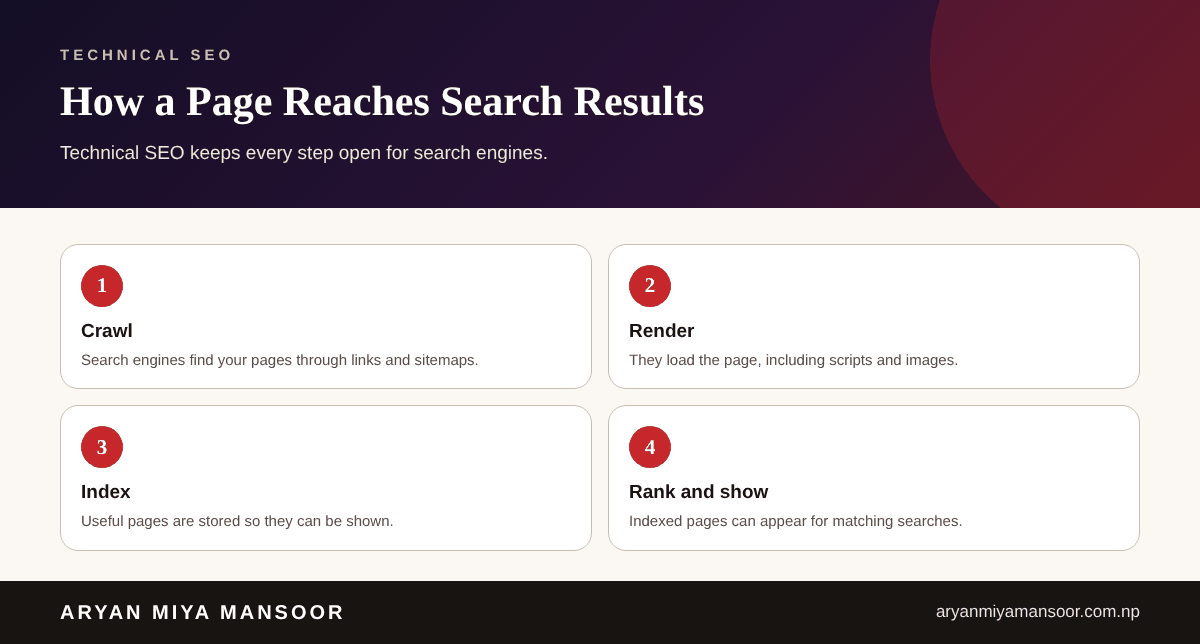
Search engines follow links and sitemaps to discover pages (crawling), load them (rendering), store useful ones (indexing) and show matching ones in results. Technical SEO keeps each step open.
Crawlability and indexing
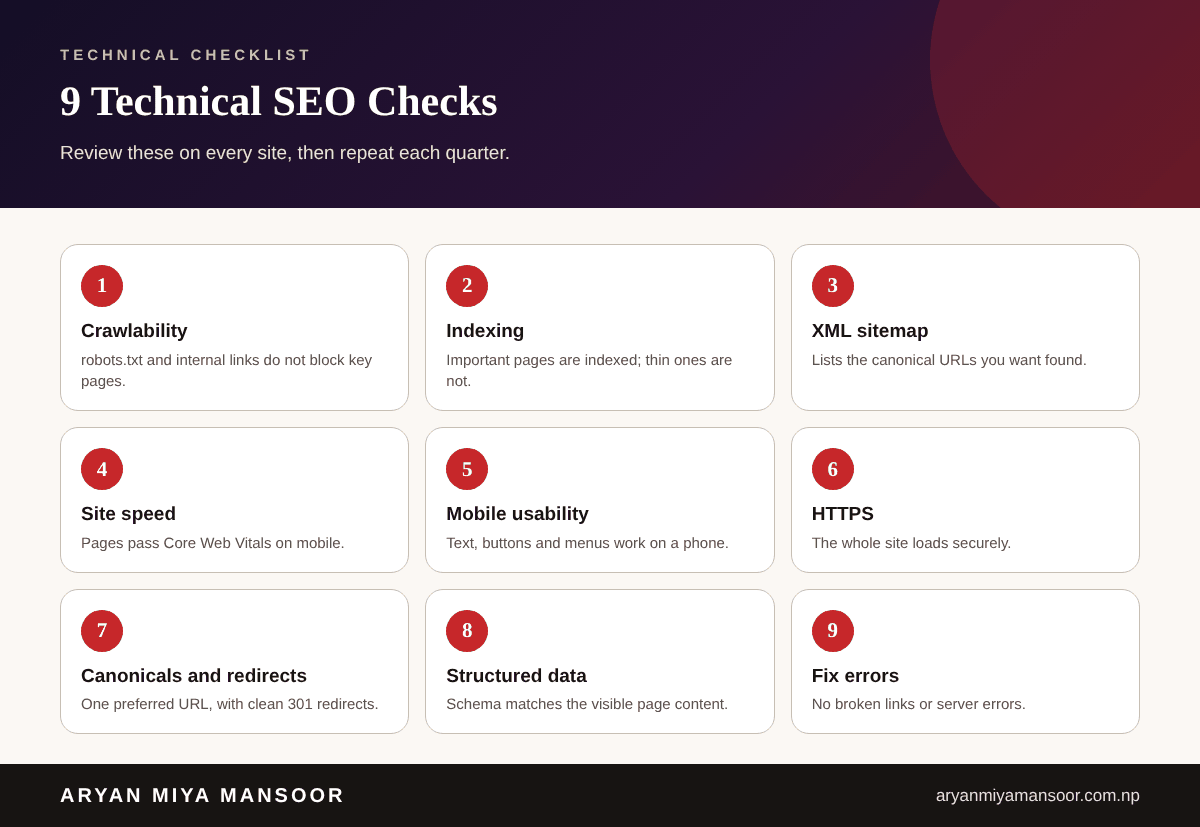
Make sure robots.txt does not block important pages, internal links connect your site and key pages are not marked noindex by mistake. In Google Search Console, the Pages report shows which pages are indexed and the reasons others are not.
XML sitemaps
A sitemap lists the canonical URLs you want found. Keep it clean: only live, indexable pages, and submit it in Search Console.
Site speed and Core Web Vitals
Compress images, limit heavy scripts and use caching. Check Core Web Vitals on mobile, where most visitors in Nepal arrive.
Mobile usability and HTTPS
Text should be readable, buttons easy to tap and menus simple on a phone. Serve the whole site over HTTPS and fix mixed-content warnings.
Canonicals, redirects and duplicates
Choose one preferred URL for each page and use canonical tags and 301 redirects to point to it. This stops duplicate versions splitting your signals.
Structured data
Schema markup describes your page to search engines. Only mark up what is visible, and test it before publishing.
How often should you run a technical SEO check?
Review the essentials every quarter and after any major change, such as a redesign, a migration or a new plugin. A short routine catches problems before they cost you traffic.
- Check Google Search Console for indexing and crawl errors.
- Test your key pages for speed on mobile.
- Look for broken links and redirect chains.
- Confirm your sitemap and robots.txt are correct.
A regular technical review by an SEO specialist such as Aryan Miya Mansoor keeps a site healthy, so your content has a fair chance to rank.
Next steps
Run the checklist above, fix errors in order of impact, then publish with confidence. For a professional review, see my SEO expert in Nepal page and the backlink audit guide for the link side of a site audit.
Conclusion
Technical SEO is the foundation of every search strategy. Make your site easy to crawl, fast, secure and clean, and your content gets a fair chance to rank.
Related reading
Frequently asked questions
Related searches and topics
Need help applying this in your market?
Sources and further reading
- Google Search Central: Crawling and indexing overview ↗
- Google Search Central: SEO starter guide ↗
- web.dev: Core Web Vitals ↗
This guide reflects my own hands-on experience and Google's published guidance at the date shown. Search changes, so check official documentation for the latest rules. Results vary by business and market; nothing here is a guarantee.
Aryan is Technical Director and SEO Manager at Softsaro Nepal and a senior SEO specialist with over 4 years of hands-on experience in SEO, Answer Engine Optimization and Generative Engine Optimization. He is based in Kathmandu, Nepal, and works remotely with businesses in Nepal and the UAE as an independent consultant, following Google’s published guidelines with no link schemes or ranking guarantees.