Banner Ad Sizes That Work
The most common display and social banner sizes, what each is good for and how to choose sizes for your budget and audience.

The most widely used display banner sizes are 300x250 (medium rectangle), 728x90 (leaderboard), 336x280 (large rectangle), 300x600 (half page), 160x600 (wide skyscraper), 970x90 (large leaderboard), 320x50 and 320x100 (mobile banners). Choose sizes that fit your audience's devices and placements, and confirm current specifications on each ad platform before you design.
- 1Standard sizes get far more available placements than unusual ones.
- 2Mobile banners and rectangles perform well because they fit phones and content areas.
- 3Plan for several sizes from one design, and keep key text away from edges.
- 4Always check the current specifications in Google Ads and each social platform.
A great ad can fail simply because it does not fit the space. Choosing the right banner size gives your campaign more places to appear and a better chance of being seen. This guide explains the standard sizes, what each is good for and how to choose. It is written by ARYAN MIYA MANSOOR, a digital marketing consultant in Lalitpur, Nepal.
What are the standard banner ad sizes?
Standard sizes are formats that most ad networks and websites support. Because many publishers sell the same slots, designing for them gives you more reach and usually lower effort.

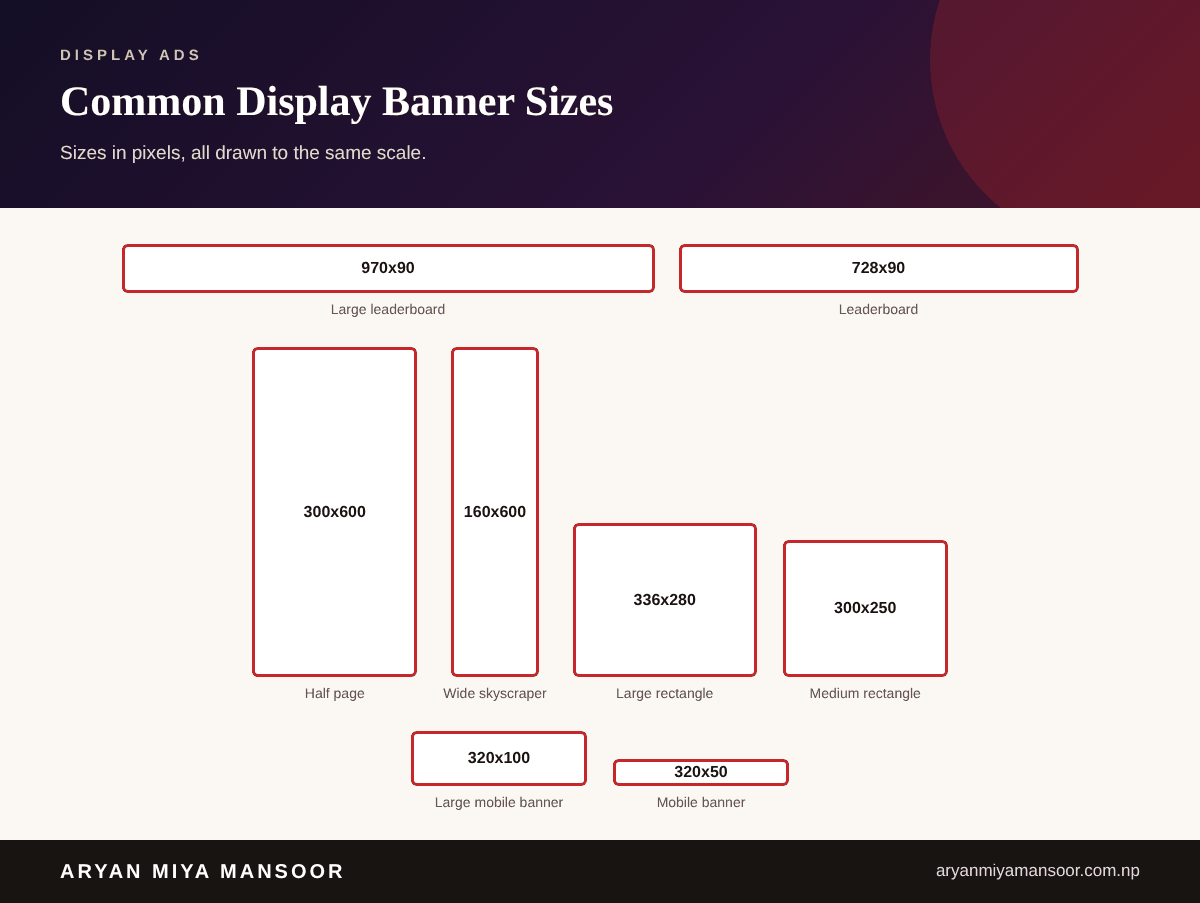
Common display banner sizes
- Medium rectangle (300x250): fits inside articles and sidebars, and works well on mobile.
- Leaderboard (728x90): sits at the top of desktop pages.
- Large rectangle (336x280): a bigger in-content option.
- Half page (300x600): tall, with room for a strong message and image.
- Wide skyscraper (160x600): a narrow sidebar format.
- Large leaderboard (970x90): a wide top-of-page format on desktop.
- Mobile banners (320x50 and 320x100): built for phone screens.
Social media ad shapes
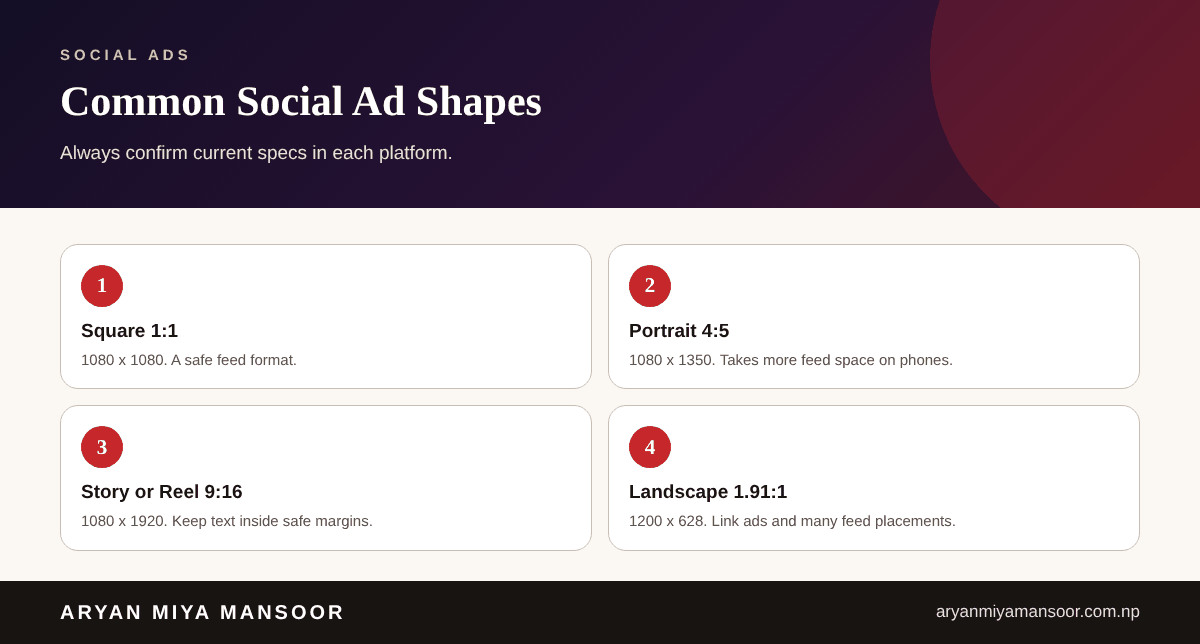
Social platforms use shapes rather than fixed banner slots. Square and portrait suit the feed, and vertical suits stories and reels. Keep text and logos inside safe margins because buttons and captions may cover the edges.
How to choose the right size
Your audience
If most of your customers browse on phones, prioritise mobile banners and medium rectangles.
Placement
In-content sizes are often seen more than ads placed far from the main text.
Budget and effort
More sizes mean more design work. Start with a small core set and add sizes where results justify it.
Your message
Tall formats suit more detail, while thin formats need a short line and a clear button. Keep one idea per ad.
Design tips for every banner size
- Use one clear message and one button in each banner.
- Keep text large enough to read on a phone.
- Leave margin around the edges so nothing is cut off.
- Show your logo clearly but do not let it crowd the offer.
- Use the same colours and fonts across sizes so your brand is easy to recognise.
How to test banner ad sizes
Run the same message in two or three sizes and compare click-through rate and cost per result after enough impressions. Keep the test fair by changing one thing at a time. Aryan Miya Mansoor suggests keeping the best size and retiring weak ones, so your budget goes where it works.
Next steps
Pick your core sizes, create clear designs and check platform specs before launch. If you want help planning campaigns, see my Google Ads service in Nepal and Meta Ads service in Nepal pages.
Conclusion
Standard sizes give you reach and simplicity. Start with a few proven formats, design for phones, test and improve. Always confirm the latest specifications in the Google Ads Help Center and the Meta Ads Guide.
Related reading
Frequently asked questions
Related searches and topics
Need help applying this in your market?
Sources and further reading
This guide reflects my own hands-on experience and Google's published guidance at the date shown. Search changes, so check official documentation for the latest rules. Results vary by business and market; nothing here is a guarantee.
Aryan is Technical Director and SEO Manager at Softsaro Nepal and a senior SEO specialist with over 4 years of hands-on experience in SEO, Answer Engine Optimization and Generative Engine Optimization. He is based in Kathmandu, Nepal, and works remotely with businesses in Nepal and the UAE as an independent consultant, following Google’s published guidelines with no link schemes or ranking guarantees.