

Track Your ChatGPT Traffic
A practical guide to finding visits from ChatGPT in your analytics, understanding what they do and improving your chances of being cited.

To track ChatGPT traffic, open the traffic acquisition report in Google Analytics 4 and look for sessions whose source contains chatgpt.com or related AI sources, then check the landing pages and outcomes. Referral data is incomplete because some AI visits arrive without a source, so use it as a minimum, and improve visibility with clear answers, structure and trustworthy content.
- 1ChatGPT visits often show in GA4 as referrals from chatgpt.com, but not every AI visit is labelled.
- 2Look at landing pages and conversions, not just visit counts.
- 3Treat the numbers as a minimum, and track trends over time.
- 4Clear answers, real expertise and consistent details help you get cited.
More people now ask ChatGPT questions that used to go to Google, so business owners ask a new question: is any of that traffic coming to my website? This guide shows how to find ChatGPT visits in your analytics, how to read them honestly and how to improve your chances of being cited. It is written by ARYAN MIYA MANSOOR, an SEO and AI search consultant in Lalitpur, Nepal.
Why ChatGPT traffic matters
AI assistants are becoming a place where customers research and compare. When an answer links to your site, the visitor often arrives with a clear question and strong interest. Even small numbers can be worth tracking, because they show which pages AI systems consider useful.

How to track ChatGPT traffic
Step 1: Open your acquisition report
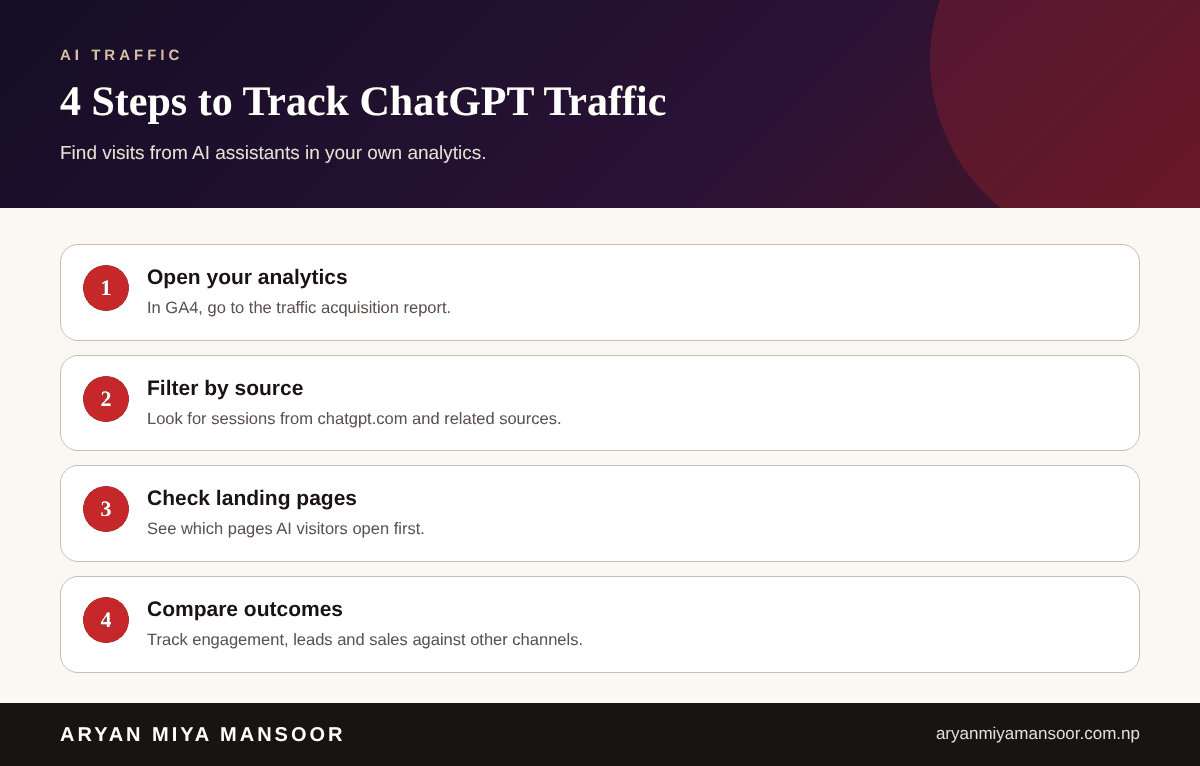
In Google Analytics 4, open the traffic acquisition report and choose session source or source and medium.
Step 2: Filter for AI sources
Search for chatgpt.com and related names. Create a saved segment or exploration so you can reuse it every month.
Step 3: Check the landing pages
See which pages AI visitors open first. These are the pages that answer questions well, and they tell you what to improve and what to expand.
Step 4: Compare outcomes
Compare engagement, enquiries and sales with other channels. A small, high-intent channel can matter more than a large one.
Can you check competitors' ChatGPT traffic?
You cannot see another website's analytics. Some third-party tools estimate AI visibility by testing prompts and recording which brands appear. Use them for direction, not as exact numbers. A simple manual test also works: ask ChatGPT the questions your customers ask and note who is mentioned.
How to improve your ChatGPT visibility
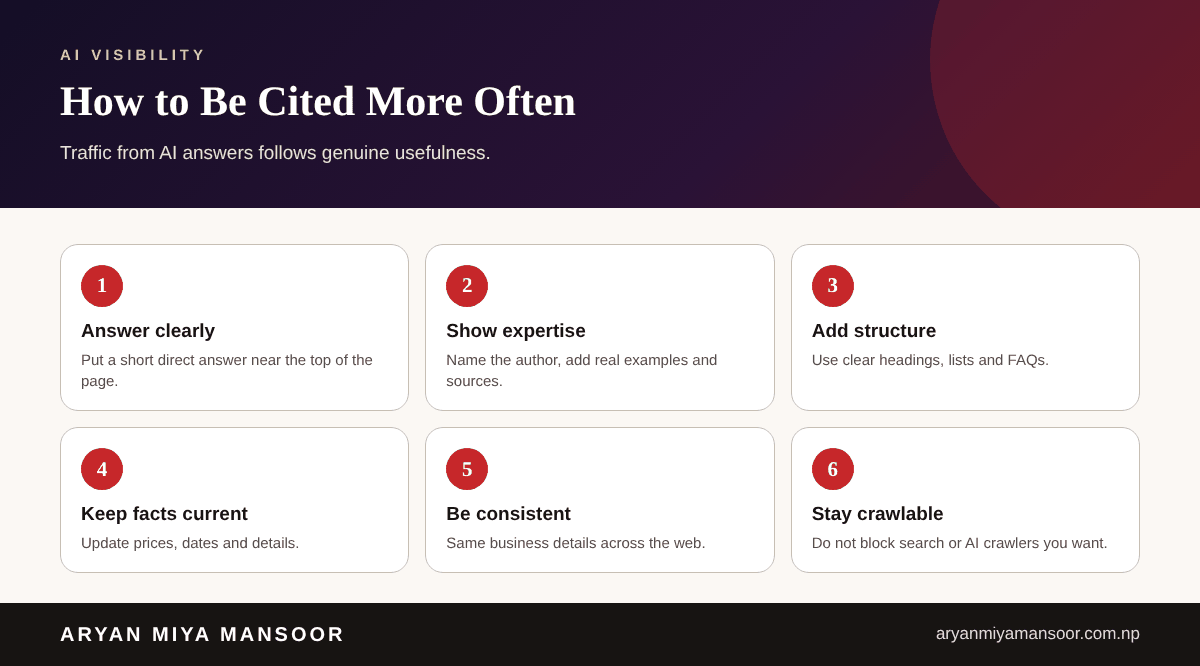
The same fundamentals that help in Google help here: clear answers, real expertise and trustworthy details. My work on GEO expert in Nepal and answer engine optimization follows these principles. Make sure your pages are helpful, your business details are consistent and your site is easy to crawl.
Build a simple monthly report
- Sessions from AI sources and their landing pages.
- Engagement and conversions from those sessions.
- Brand searches in Google Search Console.
- A short list of pages to improve next month.
What to do with your ChatGPT traffic data
Once you can see AI visits, turn the numbers into actions. Look at the landing pages that receive AI visitors and ask why they were chosen: usually they answer a clear question, include specific details and load quickly.
- Update the pages that receive AI visits so facts, prices and dates stay current.
- Add a short direct answer near the top of important pages.
- Create new pages for questions your customers ask that you do not yet cover.
- Add a clear next step, such as a contact button, to pages that attract AI visitors.
Aryan Miya Mansoor recommends reviewing this data monthly. Trends over several months are more reliable than any single week.
Conclusion
Tracking ChatGPT traffic is straightforward, but the numbers are only part of the story. Measure what you can, keep improving your pages and watch the trend. For help setting this up, see my SEO expert in Nepal page.
Related reading
Frequently asked questions
Related searches and topics
Need help applying this in your market?
Sources and further reading
- Google Analytics Help ↗
- Google Search Central: Creating helpful, reliable, people-first content ↗
- Google Search Central: SEO starter guide ↗
This guide reflects my own hands-on experience and Google's published guidance at the date shown. Search changes, so check official documentation for the latest rules. Results vary by business and market; nothing here is a guarantee.
Aryan is Technical Director and SEO Manager at Softsaro Nepal and a senior SEO specialist with over 4 years of hands-on experience in SEO, Answer Engine Optimization and Generative Engine Optimization. He is based in Kathmandu, Nepal, and works remotely with businesses in Nepal and the UAE as an independent consultant, following Google’s published guidelines with no link schemes or ranking guarantees.