
Link Building That Works
Which link building methods still work, how to judge link quality and what to avoid. A practical, safe approach to earning links.

Link building is the practice of earning links from other websites to yours. What works is creating content worth citing, sharing original data, building real partnerships, offering genuinely helpful guest content and earning local links. Judge every link by relevance and naturalness, and avoid buying links or joining link schemes, which Google warns against.
- 1Earn links by being genuinely useful, not by paying or exchanging for them.
- 2Relevance and trust matter more than the number of links.
- 3Original data, helpful guides and real partnerships are reliable link sources.
- 4Check every link opportunity against a simple quality test.
Links are still one of the strongest signals on the web, but the way to earn them has changed. This guide explains link building that works, how to judge link quality and what to avoid. It is written by ARYAN MIYA MANSOOR, an SEO consultant in Lalitpur, Nepal.
What is link building in SEO?
Link building means earning links from other websites to yours. A link works like a recommendation: it tells readers and search engines that your page is worth a visit.

What makes a link valuable?
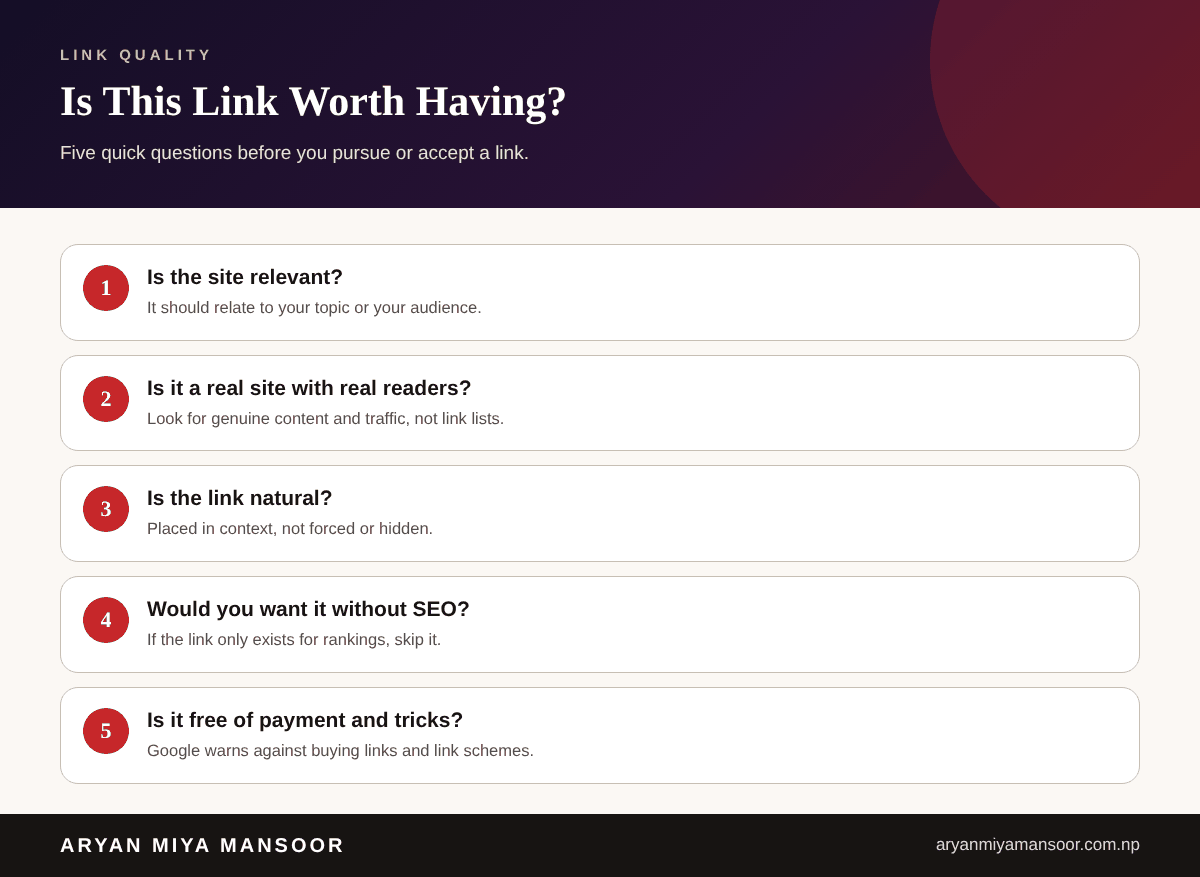
Not all links are equal. Valuable links come from relevant, trusted sites, sit naturally inside helpful content and send real visitors. A link from a respected industry site is worth far more than dozens from unrelated pages.

Link building methods that work
Create content worth citing
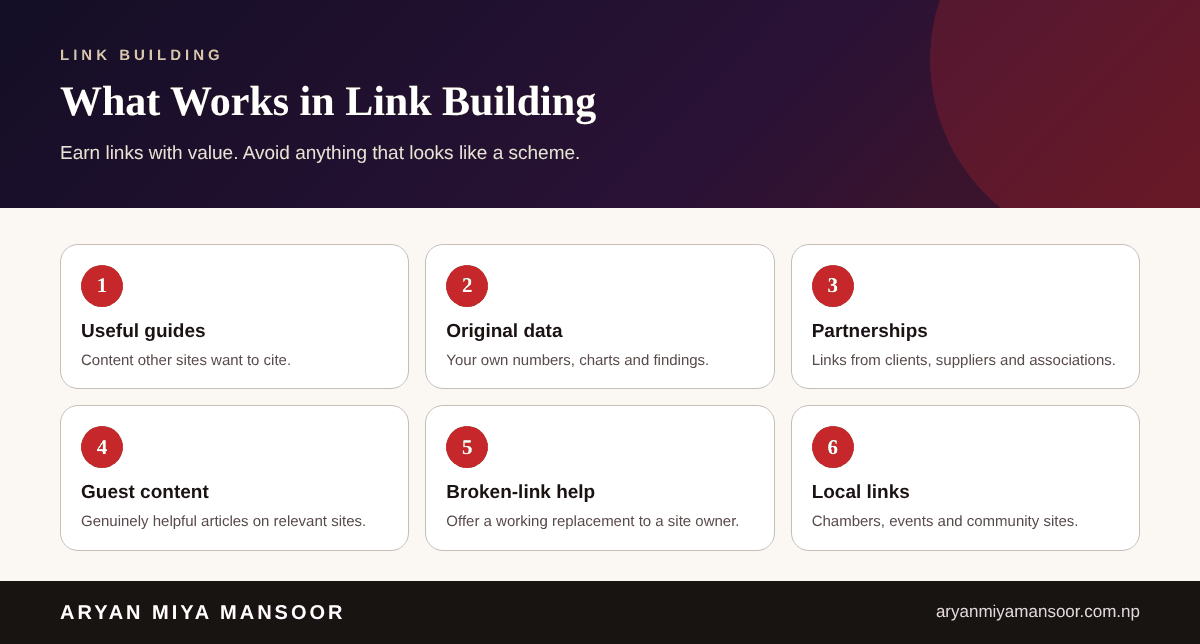
Clear guides, checklists and tools get referenced, and practical examples help most. For a model, see my on-page SEO checklist.
Share original data
Your own numbers, survey results or case findings give writers something new to cite. Even a small local dataset can earn attention.
Build real partnerships
Clients, suppliers, associations and event organisers often link to partners. Ask politely and offer something useful in return.
Offer helpful guest content
Write genuinely useful articles for relevant sites. Focus on helping their readers, not on dropping links.
Help with broken links
If you find a broken link on a relevant site and have a good replacement page, tell the owner. It is helpful, not pushy.
Earn local links
Local business groups, community events and news sites often link to nearby businesses. This also supports your local SEO.
What to avoid in link building
- Buying links or paying for placements that pass ranking signals.
- Link exchanges, private blog networks and mass directory submissions.
- Over-optimised anchor text repeated across many sites.
- Low-quality guest posts written only to place a link.
Google's spam policies describe link schemes in detail. If you suspect harmful links, my backlink audit guide explains how to check them.
How to measure link building
Track new referring domains, referral visits and rankings for the pages you promoted. Use Search Console for links and impressions, and review quality, not just counts.
A simple monthly link building routine
Consistency beats big bursts. Spend a little time each month on the same set of activities and track what earns real mentions and visits.
- Publish one useful guide or data piece that others can cite.
- Contact a few relevant sites with a genuine reason to link.
- Share your work with communities that care about the topic.
- Review new and lost links and reply to any mentions.
Aryan Miya Mansoor's advice is to build links the way you would build a reputation: slowly, honestly and with people who respect your work.
Conclusion
The safest link building is earning attention with useful work. Create content worth citing, build real relationships and judge every link by quality. For the bigger picture, read what is off-page SEO, or see my SEO expert in Nepal page for help.
Related reading
Frequently asked questions
Related searches and topics
Need help applying this in your market?
Sources and further reading
- Google Search Central: Spam policies (link spam) ↗
- Google Search Central: SEO starter guide ↗
- Google Search Console ↗
This guide reflects my own hands-on experience and Google's published guidance at the date shown. Search changes, so check official documentation for the latest rules. Results vary by business and market; nothing here is a guarantee.
Aryan is Technical Director and SEO Manager at Softsaro Nepal and a senior SEO specialist with over 4 years of hands-on experience in SEO, Answer Engine Optimization and Generative Engine Optimization. He is based in Kathmandu, Nepal, and works remotely with businesses in Nepal and the UAE as an independent consultant, following Google’s published guidelines with no link schemes or ranking guarantees.