

Keyword Research in 6 Steps
A practical six-step method for finding the keywords your customers use, matching search intent and deciding which pages to write first.

Keyword research is the process of finding the words people type into search engines and deciding which ones your pages should target. Start with your topics, expand them with tools, check search intent, judge difficulty and value, group keywords into clusters, and prioritise pages by potential. Review results in Google Search Console and repeat regularly.
- 1Keyword research shows what customers search for, so you can build pages that answer it.
- 2Search intent matters as much as search volume.
- 3Map one main keyword to each page to avoid pages competing with each other.
- 4In Nepal, check both English and Nepali searches and local place names.
Every good SEO plan starts with keyword research. Before you write a page, you need to know what your customers actually type into Google. This guide gives you a simple six-step method you can use for any website. It is written by ARYAN MIYA MANSOOR, an SEO consultant in Lalitpur, Nepal.
What is keyword research and why does it matter?
Keyword research is the process of finding the words and phrases people use when they search, and deciding which ones your pages should aim for. It matters because it connects what you offer with what customers ask. Without it, you may publish pages nobody is searching for.

Step 1: List your topics
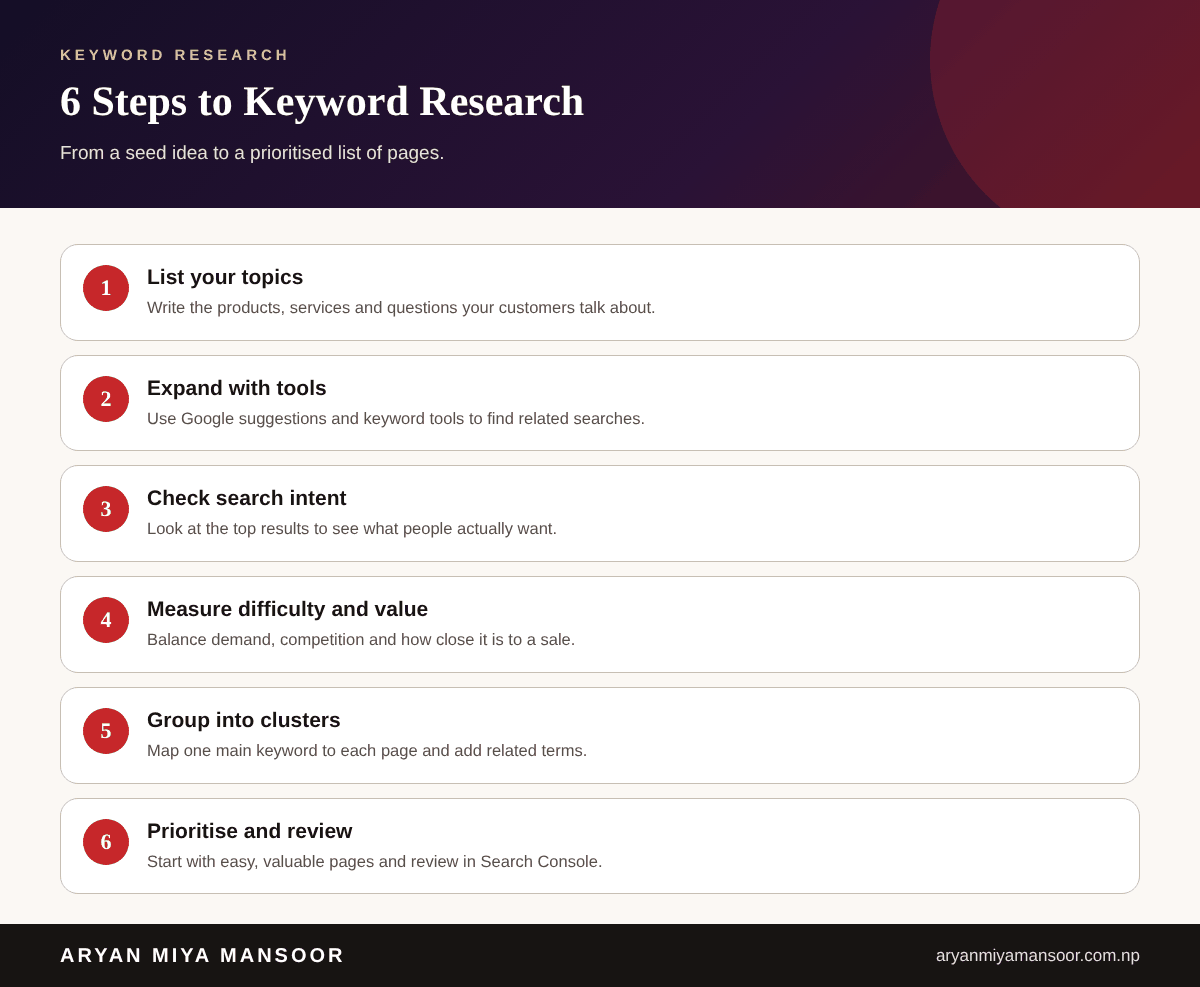
Write down your products, services, problems you solve and questions customers ask. Talk to your sales team and read real enquiries. These topics become your seed keywords.

Step 2: Expand with tools
Use Google autocomplete, the related searches at the bottom of results, People also ask and Search Console queries to find more ideas. Keyword tools add estimated volume. In Nepal, also try Nepali words and Romanised Nepali, because many people mix languages.
Step 3: Check search intent
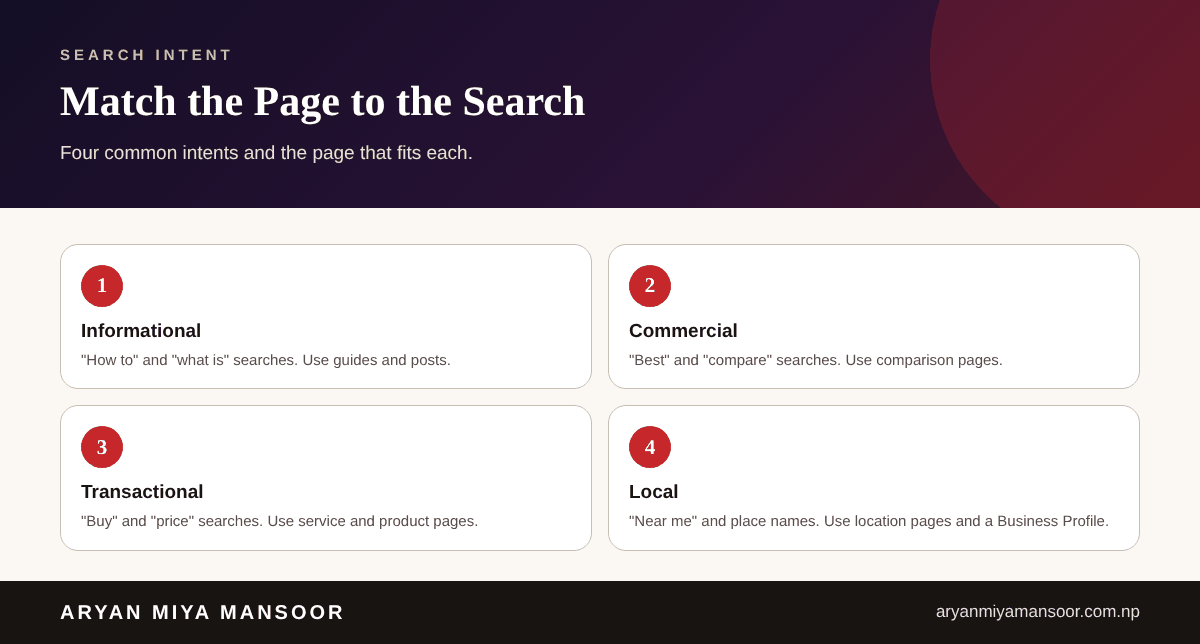
Search for the keyword yourself and look at the top results. If they are guides, a guide is likely to fit. If they are product pages, a service page fits better.
Step 4: Judge difficulty and value
Ask two questions: how hard is it to compete, and how valuable is the visitor? A less popular keyword that attracts buyers can be worth more than a popular one that brings browsers. Favour terms where your business has real experience.
Step 5: Group keywords into clusters
Group related keywords by topic and give each cluster one page. This avoids several pages competing for the same search. My local SEO guide shows how location keywords can be organised.
Step 6: Prioritise and review
Start with pages that are easy to win and close to a sale. After publishing, review Google Search Console to see which queries bring impressions and clicks, and improve pages that have many impressions but few clicks.
Turn keywords into pages
Once you have your list, write helpful pages and place the main keyword naturally in the title, heading and opening paragraph. If you need support, see my content writing service or my SEO expert in Nepal page.
Keyword research mistakes to avoid
- Chasing high volume terms that do not match what you sell.
- Ignoring search intent and targeting the wrong page type.
- Using the same main keyword on several pages.
- Never revisiting keywords after rankings change.
Review your keyword list every few months, since customer language and competition change. Aryan Miya Mansoor recommends keeping a simple sheet that maps one main keyword to each page.
Conclusion
Keyword research is not a one-off task. List topics, expand, check intent, judge value, cluster and prioritise, then review the data and repeat. Done steadily, it keeps your content aimed at real demand.
Related reading
Frequently asked questions
Related searches and topics
Need help applying this in your market?
Sources and further reading
- Google Search Central: SEO starter guide ↗
- Google Search Console ↗
- Google Search Central: Creating helpful, reliable, people-first content ↗
This guide reflects my own hands-on experience and Google's published guidance at the date shown. Search changes, so check official documentation for the latest rules. Results vary by business and market; nothing here is a guarantee.
Aryan is Technical Director and SEO Manager at Softsaro Nepal and a senior SEO specialist with over 4 years of hands-on experience in SEO, Answer Engine Optimization and Generative Engine Optimization. He is based in Kathmandu, Nepal, and works remotely with businesses in Nepal and the UAE as an independent consultant, following Google’s published guidelines with no link schemes or ranking guarantees.