AI Tools That Boost SEO
A plain-language guide to AI tools that help with SEO, grouped by job, with advice on choosing tools for your budget and business.

The best AI tools for SEO depend on the job. General assistants such as ChatGPT, Claude and Gemini help with ideas, briefs and editing. SEO platforms such as Semrush, Ahrefs and Ubersuggest add data. Google Search Console and Google Analytics measure results, and crawlers such as Screaming Frog find technical issues. Choose by task, budget and how easily you can verify the output.
- 1Pick the job first, then the tool.
- 2Combine a general AI assistant with a data tool for keywords and rankings.
- 3Free Google tools remain essential for measurement.
- 4Check features and pricing on each vendor's site, because they change often.
New AI tools for SEO appear every month, which makes it hard to know what to use. This guide groups them by job so any business can choose with confidence. It is written by ARYAN MIYA MANSOOR, an SEO and AI search consultant in Lalitpur, Nepal.
What AI tools can do for SEO
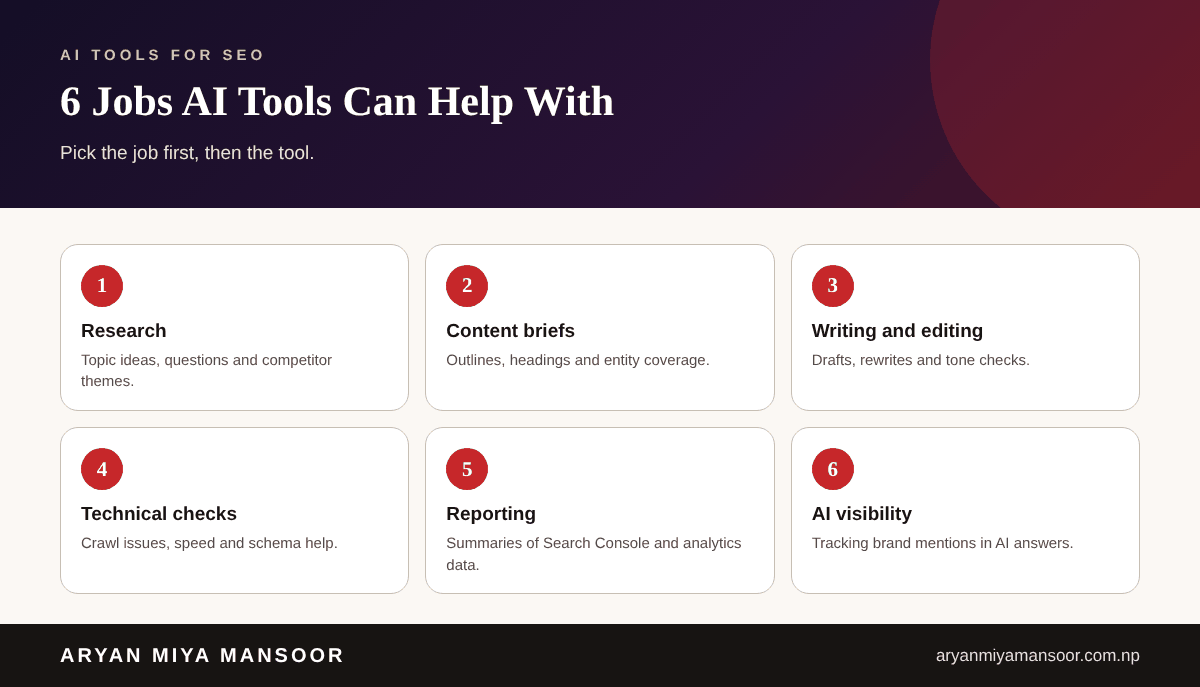

AI tools save time on repeatable work such as researching questions, drafting outlines and summarising reports. They are weaker at judging truth, so you still need to check results.
Best AI tools for SEO by job
AI assistants
ChatGPT, Claude and Gemini help with topic ideas, briefs, drafts, rewrites and explaining data. See my step-by-step guides for SEO with ChatGPT and SEO with Claude.
Keyword and competitor tools
Semrush, Ahrefs and Ubersuggest provide search volume, difficulty, competitor pages and backlinks data. Most now include AI features on top of their data.
Content optimisation tools
Tools such as Surfer, Frase and Clearscope compare your draft with top results and suggest topics to cover. Use them as a guide, not a rulebook.
Technical tools
Screaming Frog and the audits inside SEO platforms find broken links, redirects and missing tags. Read more in my technical SEO guide.
Measurement tools
Google Search Console and Google Analytics show real clicks, queries and conversions, and they are free.
How to choose the right tool
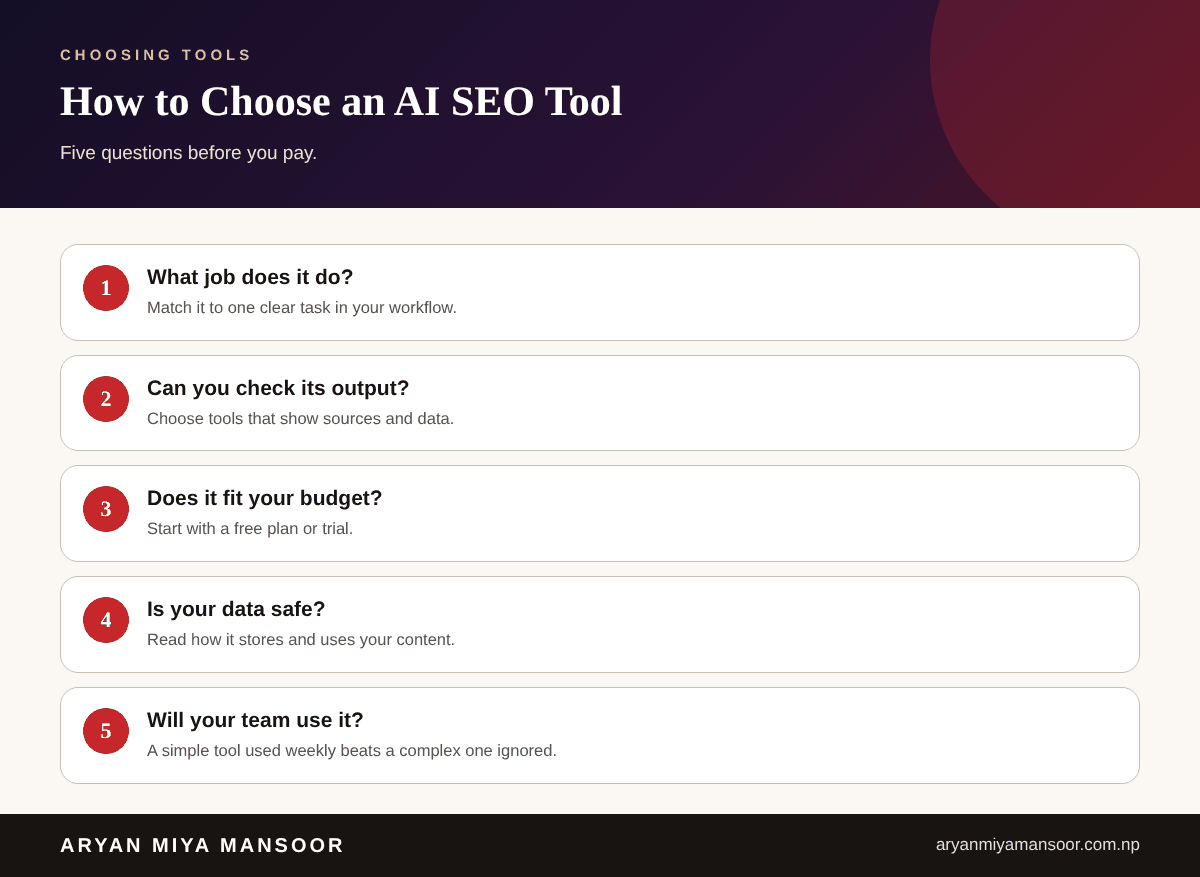
How to build a simple AI SEO toolset
A small business does not need ten subscriptions. Start with the free Google tools for measurement, add one AI assistant for ideas and drafts, and add one data tool when you need keyword volumes or competitor insight. This is the approach I recommend as an SEO consultant in Nepal, because it keeps costs low and makes it easy to see what is working.
A sample setup for a local business
- Google Search Console and Google Analytics for real performance data.
- One AI assistant for topic ideas, briefs and editing.
- A keyword tool for search volume and competitor pages.
- A crawler for a quarterly technical check.
A sample setup for a growing team
Larger teams often add a content optimisation tool, shared dashboards and a monthly review. The goal stays the same: use AI tools to save time on repeatable work, then spend that time on strategy and on creating pages that genuinely help customers.
Risks of relying on AI tools for SEO
- Wrong facts: AI can state invented numbers or sources with confidence.
- Generic content: unedited text looks like everyone else's pages.
- Data privacy: do not paste confidential customer information into tools you have not reviewed.
- Tool overload: too many tools create reports nobody reads.
Aryan Miya Mansoor's rule is simple: if you cannot check what the tool tells you, do not act on it yet. Match every AI suggestion with a trusted source or your own data first.
Conclusion
The best AI tools for SEO are the ones that fit your task, budget and ability to check the output. If you want help choosing and setting them up, see my SEO expert in Nepal page.
Related reading
Frequently asked questions
Related searches and topics
Need help applying this in your market?
Sources and further reading
This guide reflects my own hands-on experience and Google's published guidance at the date shown. Search changes, so check official documentation for the latest rules. Results vary by business and market; nothing here is a guarantee.
Aryan is Technical Director and SEO Manager at Softsaro Nepal and a senior SEO specialist with over 4 years of hands-on experience in SEO, Answer Engine Optimization and Generative Engine Optimization. He is based in Kathmandu, Nepal, and works remotely with businesses in Nepal and the UAE as an independent consultant, following Google’s published guidelines with no link schemes or ranking guarantees.