SEO With Claude, Step by Step
A practical seven-step workflow for using Claude to speed up SEO research, content briefs and editing, while keeping facts and decisions in your hands.

To do SEO with Claude, give it clear context about your business, use it to explore topics and build content briefs, draft and edit sections, and generate titles, FAQs and schema ideas. Then verify every fact and measure results in Google Search Console. Claude speeds up the work, but you supply the real experience and make the final decisions.
- 1Claude is a strong assistant for research, outlines, drafting and editing.
- 2Give it context: business, audience, location and the page goal.
- 3Always verify facts, numbers and links before publishing.
- 4Measure results in Google Search Console, not in the chat.
Claude can save hours on SEO work, but only if you use it with a clear process. This guide gives a step-by-step workflow, example prompts and the checks that keep your content accurate. It is written by ARYAN MIYA MANSOOR, an SEO and AI search consultant in Lalitpur, Nepal.
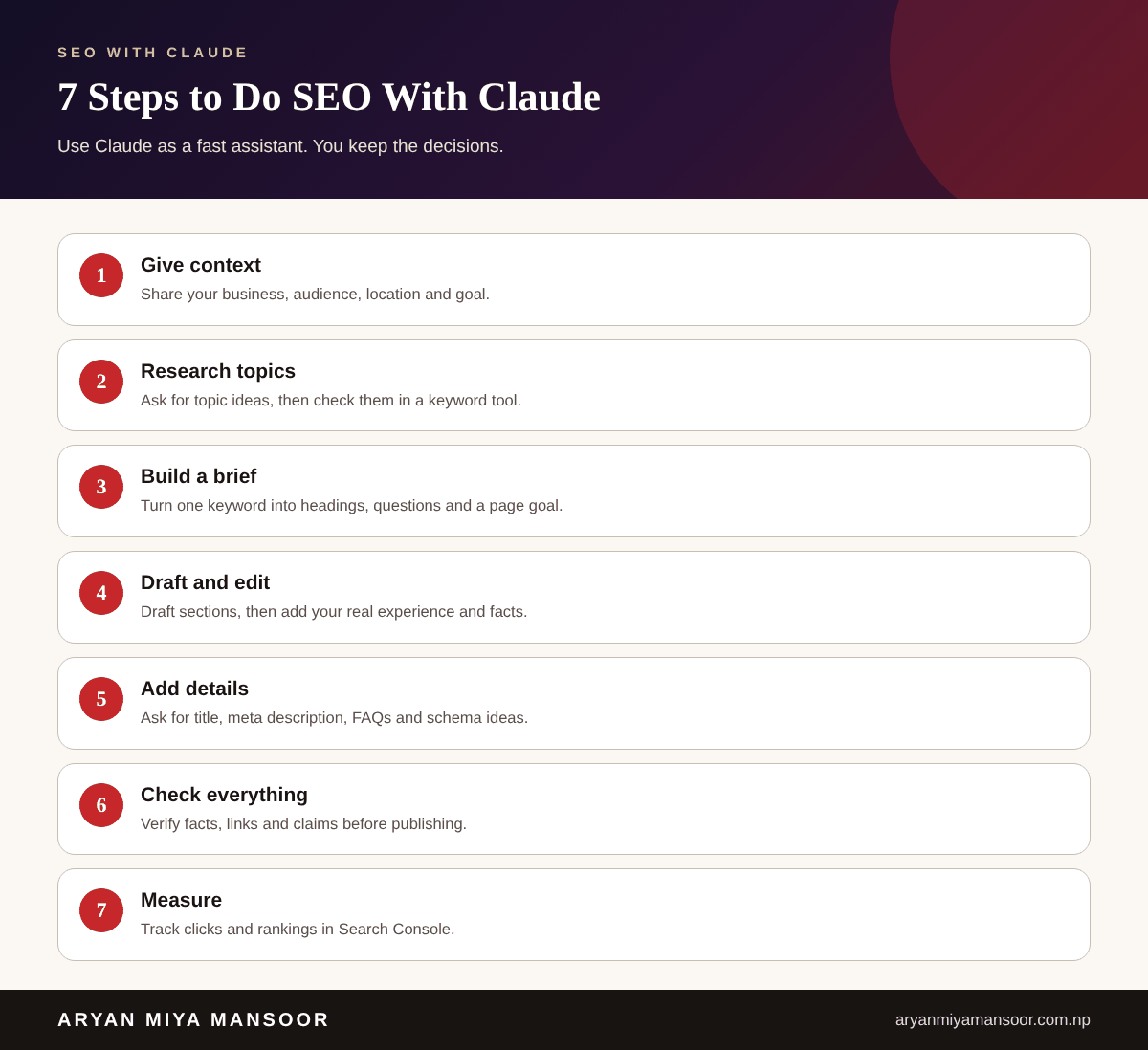
How to do SEO with Claude: 7 steps

Step 1: Give Claude context
Tell it your business, customers, city, services and the goal of the page. The better the context, the more useful the answer.
Step 2: Research topics and questions
Ask for the questions your customers ask, then group them by intent. Confirm demand in a keyword tool, as covered in my keyword research guide.
Step 3: Build a content brief
Turn one keyword into a brief with a working title, headings, questions to answer and the action you want readers to take.
Step 4: Draft and edit
Draft section by section, then rewrite with your own examples, numbers and voice. This is where real expertise separates your page from generic text.
Step 5: Add on-page details
Ask for title options, a meta description, FAQ questions and schema ideas, then check them against my on-page SEO checklist.
Step 6: Check everything
Verify every fact, figure and link. Never publish a statistic you have not confirmed from a trusted source.
Step 7: Measure
After publishing, watch clicks, impressions and queries in Google Search Console and improve the page over time.
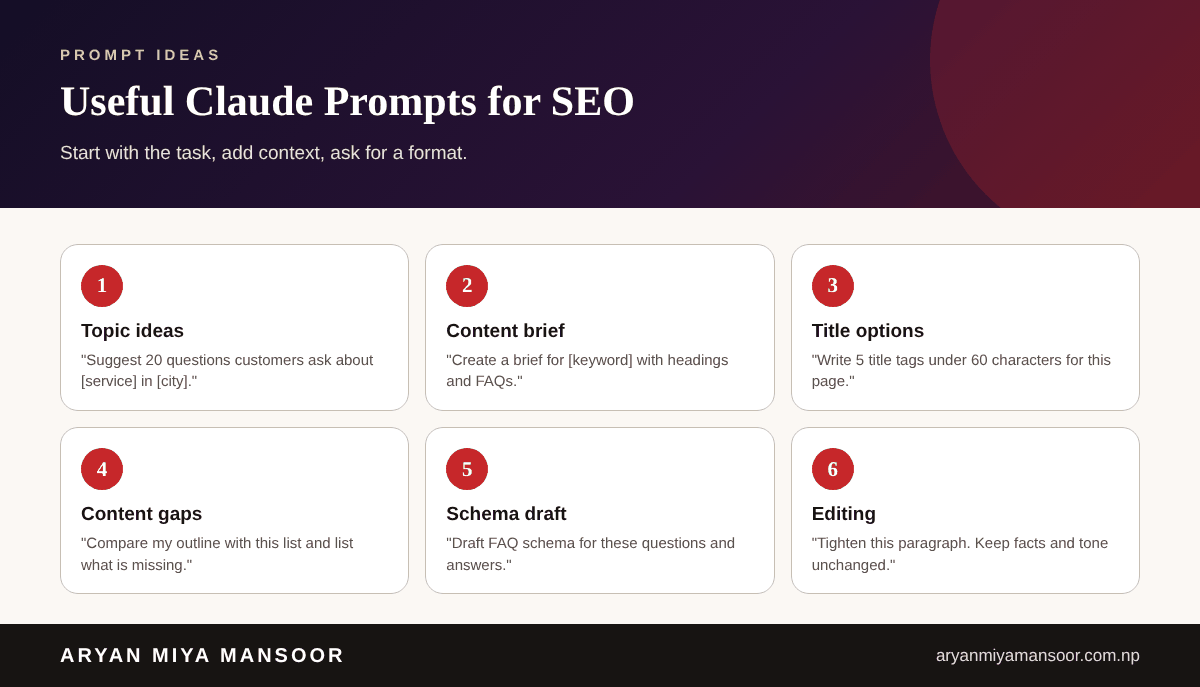
Useful Claude prompts for SEO
Mistakes to avoid
- Publishing raw output without adding experience.
- Trusting numbers, quotes or links without checking.
- Targeting a keyword without checking search intent.
- Skipping measurement after the page goes live.
Example: planning a topic cluster with Claude
A topic cluster is a main page supported by related articles. You can give Claude your main service and ask for subtopics your customers ask about. Then group the ideas by intent, choose one keyword per page and decide how the pages link to each other.
- List the main service page that should rank.
- Ask for supporting questions and group them by intent.
- Assign one main keyword to each page.
- Plan internal links between the pages.
Working with long documents and data
Claude can read long text, so you can paste in a draft, a competitor outline or an export of your page titles and ask it to find gaps, duplicates or unclear sections. This is useful for content audits, as long as you check its findings against the real pages.
Keep quality control in your hands
Ask Claude to explain why it suggests a change, then decide whether the reason is right for your customers. Good SEO with Claude is a conversation between your experience and its speed, and the experience should lead.
Conclusion
Claude makes SEO faster, but good rankings still come from helpful, accurate pages and steady improvement. If you want a workflow built for your business, see my GEO expert in Nepal and answer engine optimization pages.
Related reading
Frequently asked questions
Related searches and topics
Need help applying this in your market?
Sources and further reading
- Claude documentation ↗
- Google Search Central: Using generative AI content ↗
- Google Search Central: SEO starter guide ↗
This guide reflects my own hands-on experience and Google's published guidance at the date shown. Search changes, so check official documentation for the latest rules. Results vary by business and market; nothing here is a guarantee.
Aryan is Technical Director and SEO Manager at Softsaro Nepal and a senior SEO specialist with over 4 years of hands-on experience in SEO, Answer Engine Optimization and Generative Engine Optimization. He is based in Kathmandu, Nepal, and works remotely with businesses in Nepal and the UAE as an independent consultant, following Google’s published guidelines with no link schemes or ranking guarantees.